

How to Audit a Competitor’s Google Business Profile and Outrank Them
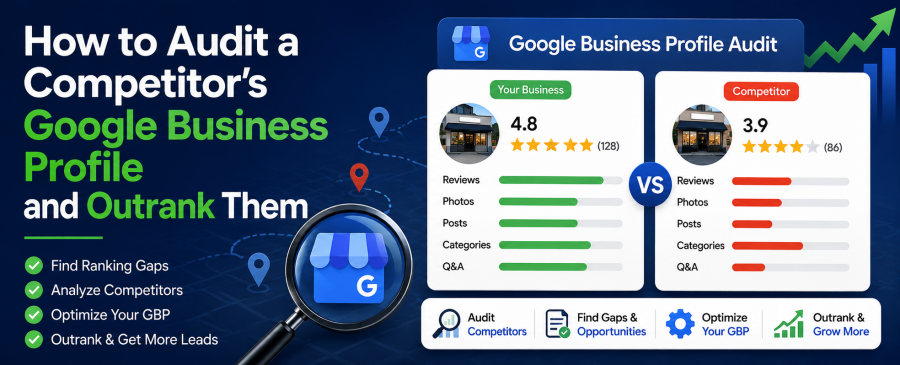
A Google Business Profile audit is a structured review of a business’s categories, services, reviews, photos, posts, NAP information, and website alignment. A competitor-focused audit helps identify the profile gaps that may be limiting local visibility and provides a prioritized roadmap for GBP optimization.
You already know your competitor by name. You’ve seen their van, their storefront, or their ad on Facebook. What you probably haven’t done is pull apart their Google Business Profile the way we do during a client audit.
A proper GBP audit isn’t about being nosy. It’s how you find the exact gaps keeping you out of the map pack. This guide walks through the audit process we use at Map Ranks, how local SEO competitor analysis feeds into GBP optimization, and how AEO, GEO, and AIO thinking now shape which listings Google’s systems trust enough to recommend. We’re leaning on real E-E-A-T signals here, our own client work, not guesses.
Key Takeaways
- A Google Business Profile audit should start with your competitors, not your own listing, so you know what “good” actually looks like in your market.
- Review velocity, category selection, and photo frequency are the fastest gaps to spot and the fastest to fix.
- Local SEO competitor analysis works best when you track three to five direct competitors, not the entire industry.
- GBP optimization is ongoing. A one-time setup fades as competitors keep posting and collecting reviews.
- Matching your website content to your GBP claims strengthens E-E-A-T and supports AI-driven local search results.
- Small, consistent profile activity outperforms sporadic bursts of effort over time.
What Is a Google Business Profile Audit, and Why Start With Competitors?
A Google Business Profile audit is a field-by-field review of categories, hours, photos, reviews, and posting activity to find what’s helping or hurting a listing’s ranking. Starting with a competitor’s profile shows you the bar you actually need to clear.
Most owners audit their own profile first and stop there. That tells you what’s wrong with your listing, but not what’s working for the business beating you. We pull three competitor profiles before touching a client’s own GBP, since the factors that matter shift by industry and city.
Step 1: Find Your Real Local Competitors
Your real competitors are whoever shows up in the map pack for your core keywords, not the biggest name in your industry nationally.
- Open an incognito window to avoid personalized results
- Search your top two or three service terms plus your city
- Note the three businesses in the local pack
- Repeat for nearby neighborhoods if you serve a wider area
Pick three to five of these for your analysis. Any more and it gets too broad to act on.
Step 2: Audit Their Categories, Attributes, and Business Description
Check whether their primary category matches exactly what a searcher is looking for, and note every secondary category they’ve added that you haven’t.
We often find a competitor using three or four secondary categories a business owner never thought to add. A general contractor might also be tagged as a kitchen remodeler and a bathroom remodeler, pulling in extra searches you’d otherwise miss. Attributes matter too. Things like “women-owned” or “free estimates” show up as filters in Google Maps, and skipping them quietly costs visibility.
Step 3: Analyze Review Velocity, Rating, and Response Pattern
Count how many reviews a competitor earns per month, not just their star rating. Google weighs recent review activity more heavily than an old, static count.
Look at three things:
- Velocity. Five reviews a month, or one every few months?
- Response rate. Do they reply to every review, including negative ones?
- Response speed. Same-day replies signal an active profile.
A business with 80 reviews and zero owner responses is often easier to outrank than one with 40 reviews and a consistent reply habit.
Step 4: Check Their Photos, Posts
Fresh photos and regular Google Posts tell Google a profile is actively managed. An inactive competitor profile is one of the easiest gaps to exploit.
During audits, we track:
- How recently new photos were uploaded
- Whether Google Posts go out weekly, monthly, or not at all
- Whether photos are professional or customer-submitted only
A competitor who hasn’t posted in eight months may present an opportunity to differentiate your profile through consistent, useful updates.
Step 5: Compare NAP Consistency and Citation Strength
Search the competitor’s business name and check whether their name, address, and phone number match exactly across Yelp, Bing Places, and industry directories.
Inconsistent NAP data is more common than you’d expect, even among businesses ranking well. A competitor with a mismatched suite number or an old phone number floating around directories has a trust signal working against them, and that’s a spot where your clean data can pull ahead.
Step 6: Check Website-to-Profile Alignment
Check if a competitor’s GBP claims match their actual website. If they don’t, that mismatch weakens the trust signals AI-driven local search now relies on.
Look for three things: LocalBusiness schema on their site, service-specific landing pages, and whether their homepage actually mentions the services listed on their profile. Most local sites fail at least one of these. If theirs is thin and generic, build a schema-rich, service-specific page on your side. That’s a clear signal you’re handing Google, and one they never gave.
We break down this exact process in more detail in our post on advanced Google Business Profile optimization techniques for competitive markets.
Turning the Audit Into a Google Business Profile Ranking Strategy
Once you’ve mapped the gaps, prioritize fixes by effort versus impact, starting with what your competitor has ignored the longest.
- Fix your own categories and attributes first. It’s fast and free.
- Build a review habit that beats their monthly velocity, even by a small margin.
- Match or exceed their posting frequency for photos and updates.
- Clean up your citations so your NAP data is airtight everywhere.
- Build out service pages with schema that back up your GBP claims.
Track your position weekly while you work through this list. Our guide on how to check your Google Maps rank covers grid-based tracking if you want to measure movement accurately instead of guessing from a single search. It also helps to keep Google’s own explanation of relevance, distance, and prominence in mind, since every fix in this list maps back to one of those three factors.
Case Study: What a Real GBP Audit and Optimization Push Looks Like
We worked with Tint World, a multi-location automotive customization franchise, on this same profile-by-profile optimization across 150 locations. Keeping every listing accurately categorized, updated, and aligned with local search signals grew website visitors 36% year over year and phone calls 21%, while strengthening its position against local competitors in each market.
We saw a similar pattern with CoolVu, a window tinting franchise, where phone calls jumped over 1,200% after a full profile cleanup across their network. Neither result came from a single trick. Both came from the audit-then-fix process above, applied consistently. Full numbers are on our case studies page.
Building E-E-A-T While You Optimize
E-E-A-T isn’t a separate checklist item. It’s the byproduct of doing the audit work honestly and keeping your profile and website aligned with reality.
- Experience: Show real job photos, not stock imagery.
- Expertise: Name real team members in your description and on your site.
- Authoritativeness: Earn citations from local organizations, not just generic directories.
- Trust: Keep your NAP data, reviews, and website claims pointing to the same facts.
If you’d rather have a dedicated team run this audit and the ongoing optimization for you, our Google Maps Optimization service covers the full process. You can also start with a free scan on our homepage to see where your profile stands today.
If you’re unsure where your Google Business Profile stands against local competitors, Map Ranks can help. Our team provides GBP audits and ongoing Google Maps optimization to identify gaps, strengthen your local presence, and improve visibility. Get in touch with us at 800-638-6384 to discuss your profile.
Frequently Asked Questions
What is a Google Business Profile audit?
A GBP audit is a review of every field, signal, and activity pattern on a GBP listing, including categories, hours, photos, reviews, and posts, to find what is helping or hurting its ranking.
How do I find out who my real local SEO competitors are?
Search your main service keywords plus your city in an incognito browser and note whichever three businesses show up in the map pack. Those are your real competitors, not just the biggest brand names in your industry.
What should I look at during a local SEO competitor analysis?
Check their GBP categories, review count and response rate, photo and post frequency, NAP consistency across citations, and whether their website content matches their profile claims.
How long does it take to improve Google Business Profile ranking after an audit?
Most businesses see initial movement within 30 to 60 days after fixing the gaps found in an audit, with stronger gains building over 90 days as reviews and citations accumulate.
Is GBP optimization a one-time task or ongoing work?
It’s ongoing. Competitors keep adding reviews and posts, so GBP optimization needs regular updates, not a single setup, to hold a ranking position.

Map Ranks is a local SEO agency that helps businesses get found fast on Google Maps and local pack. Our team specializes in Google Maps Marketing, SEO, and optimization strategies designed to boost your visibility, attract nearby customers, and grow your local presence. We make sure your local business stands out right where it matters; on the map and in front of the people searching for you.