

How to Optimize Your Google Business Profile for “Near Me” Searches
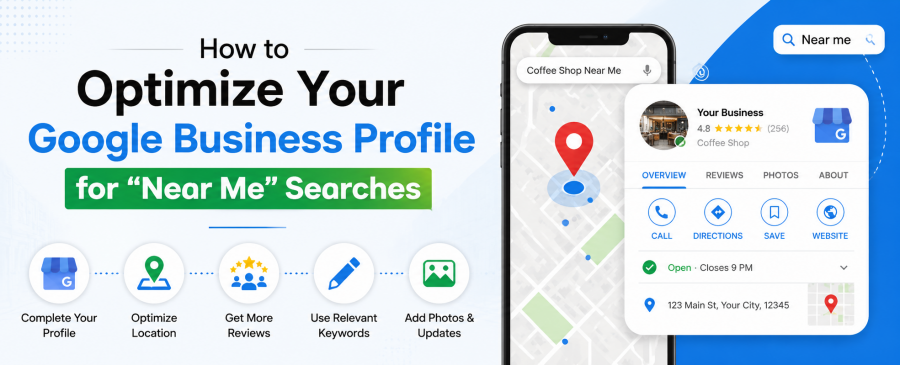
We’ve watched local businesses lose customers to competitors who simply show up first when someone types “near me.” You might have better service, better pricing, or even a better location. If your Google Business Profile isn’t built for these location-based searches, none of that matters. The customer never sees you.
This guide covers exactly what we do at Map Ranks on every new Google Business Profile Optimization project. No fluff about “filling out your profile completely.” Just the specific levers that move rankings for local, nearby-intent searches, pulled from real client work. We also watch how AI-driven search is reshaping local visibility. As search shifts toward AEO (Answer Engine Optimization), GEO (Generative Engine Optimization), and AIO (AI Overviews), the businesses that win are the ones with clean, structured, trustworthy profiles. That’s the E-E-A-T foundation this whole guide is built on.
Key Takeaways
- “Near me” rankings are driven by three factors: proximity, relevance, and prominence. You can influence two of the three directly.
- Category selection matters more than most business owners realize. Wrong category, and you’re invisible for local searches.
- Photos, posts, and review responses are ranking signals, not just decoration.
- NAP (Name, Address, Phone) consistency across the web still affects trust and rankings in 2026.
- AI-driven search tools (AI Overviews, ChatGPT, Perplexity) increasingly pull from structured GBP data, so schema and consistency matter more than ever.
- Multi-location brands need location-specific optimization, not a copy-paste approach.
What Counts as a Local Search With Nearby Intent?
A local search with nearby intent is any query where the searcher expects Google to use their location to find relevant businesses in the area. They may type a phrase such as “plumber near me” or simply search for “plumber” while location signals are available.
Google can understand local intent even when the exact phrase is not used. Effective GBP optimization is therefore less about repeating a location phrase and more about making your profile relevant, accurate, trustworthy, and useful for the local audience you want to reach.
How Google Ranks Local Businesses
Google ranks local results using three factors: proximity, relevance, and prominence. Your profile’s completeness and activity directly influence two of them.
Proximity
Mostly out of your hands. Google estimates how far the business is from the searcher. You can’t move your storefront, but you can make sure your address, service area, and pin location are set up correctly, since errors here quietly kill your proximity score.
Relevance
This is where GBP optimization does the heaviest lifting. Google reads your categories, description, services, posts, and review text to decide if you match the searcher’s intent. A vague, generic profile reads as low relevance, even if you’re the best business around.
Prominence
Prominence is your reputation, online and off. Review count, review rating, backlinks, citations, and listing engagement all feed into this. It’s slower to build, but it compounds. A profile with 200 reviews and weekly posts will outrank a barebones one nearly every time.
Step-by-Step: Optimizing Your GBP for Near Me Searches
1. Pick the Right Primary Category
Your primary category tells Google what business you are before it reads your description. Pick too broad (“Contractor” instead of “Roofing Contractor”) and you’ll get buried under specific competitors. We check this first on every new account, and it’s shocking how often it’s wrong.
2. Write a Description That Describes What You Actually Do
Skip the corporate speak. Say what services you offer, where, and what makes you different. Weave in terms of real customers’ searches, your city, your neighborhood, and specific services. Don’t force “near me” itself. Google doesn’t need it typed there.
3. Add Every Relevant Service and Product
Empty service lists waste an opportunity. List emergency repairs, weekend appointments, and free estimates individually. This gives Google and AI search tools more specific hooks to match you against long-tail, nearby-intent queries.
4. Upload Photos Weekly, Not Once
Profiles with fresh photos get more engagement, and engagement is a ranking signal. Interior shots, completed jobs, before-and-afters. Businesses that upload consistently see stronger listing view growth than those that upload once and forget it.
5. Post Like You Mean It
GBP Posts aren’t just an announcement board. A short weekly post about a promotion or completed project keeps your profile “active” in Google’s eyes. Active profiles rank better for local, in-the-area searches.
6. Respond to Every Review
Review responses are additional text Google can crawl, packed with service and location keywords if written well. “Thanks for trusting us with your AC repair in [neighborhood]” does double duty as courtesy and content.
7. Fix NAP Inconsistencies Across the Web
If your phone number on Yelp doesn’t match your GBP, or an old address is still live on some directory, that inconsistency chips away at trust signals. We run citation audits specifically to catch this.
A Real Example: What This Looks Like at Scale
We recently handled Google Business Profile optimization for a national dog daycare franchise with over 250 locations. Each location needed the same fundamentals applied: correct categories, consistent NAP, weekly posts, active review management, and tailored to its own neighborhood.
The result was a jump from roughly 449,000 to nearly 530,000 website visitors year over year, plus a 26% increase in direction requests and phone calls. That’s what happens when GBP optimization gets applied consistently across every listing, not treated as a one-time setup task.
See the full breakdown, along with results from other multi-location brands, on our case studies page.
Common Mistakes That Quietly Kill Near Me Rankings
- Choosing a category that sounds impressive instead of one matching search intent
- Leaving the description untouched since the profile was created
- Ignoring negative reviews instead of responding professionally
- Inconsistent hours across GBP, the website, and directories
- Treating GBP as a one-time setup instead of an ongoing channel
Where AI Search Fits Into This
Location-based searches aren’t staying inside Google Maps forever. Tools built around Answer Engine Optimization and Generative Engine Optimization now pull local business data directly into AI-generated answers. If someone asks an AI assistant, “Where’s a good electrician near downtown?” it’s pulling from the same structured, trustworthy data, categories, descriptions, and review signals we covered above. AIO matters for local businesses now, not later. For a deeper breakdown of the ranking signals AI engines rely on, check our blog post on Google Business Profile ranking factors.
How We Approach This at Map Ranks
Every account we manage starts with a full audit against these exact factors. Our Google Business Profile Optimization service covers category corrections, weekly posting, photo management, review strategy, and citation cleanup. For businesses needing broader visibility beyond the Map Pack, we pair this with our Google Maps SEO service to strengthen organic local rankings too.
Google’s own guidance on local search ranking factors confirms relevance, distance, and prominence remain the three pillars of local ranking, which lines up with what we see across client accounts every week.
Ready to Fix Your Near-Me Visibility?
If your business isn’t showing up when nearby customers search, it’s costing you calls right now, not next quarter. Talk to the Map Ranks team about a free listing scan and see exactly where your profile is losing ground.
Frequently Asked Questions
How long does Google Business Profile optimization take to show results?
Small improvements, more listing views, and calls usually show within two to four weeks. Meaningful ranking movement for competitive near-me searches takes 60 to 90 days of consistent activity.
Which Google Business Profile elements matter most for local rankings?
Your primary category, services, business description, accurate location information, photos, posts, review activity, and consistent business details across the web all contribute to local visibility. The strongest profiles keep these elements accurate, complete, and actively maintained.
How often should I update my Google Business Profile?
There is no single update schedule for every business, but regular activity is important. Keep hours, services, photos, posts, and business information current, and respond to reviews consistently. Review your profile whenever your business details or offerings change.
Why did my local rankings drop even though I didn’t change anything?
Google updates its local systems, and competitors continue optimizing their profiles. A ranking drop can happen when other businesses improve their relevance, prominence, content, reviews, or overall local signals faster than you do.
Does having a service area business without a storefront hurt local rankings?
It can limit visibility compared with a storefront in a dense area, but it is not disqualifying. Accurate service areas, a complete profile, and consistent activity can still help a service area business compete in its target locations.

Map Ranks is a local SEO agency that helps businesses get found fast on Google Maps and local pack. Our team specializes in Google Maps Marketing, SEO, and optimization strategies designed to boost your visibility, attract nearby customers, and grow your local presence. We make sure your local business stands out right where it matters; on the map and in front of the people searching for you.