

Google Maps Ranking Report: What Your Local SEO Scan Actually Tells You
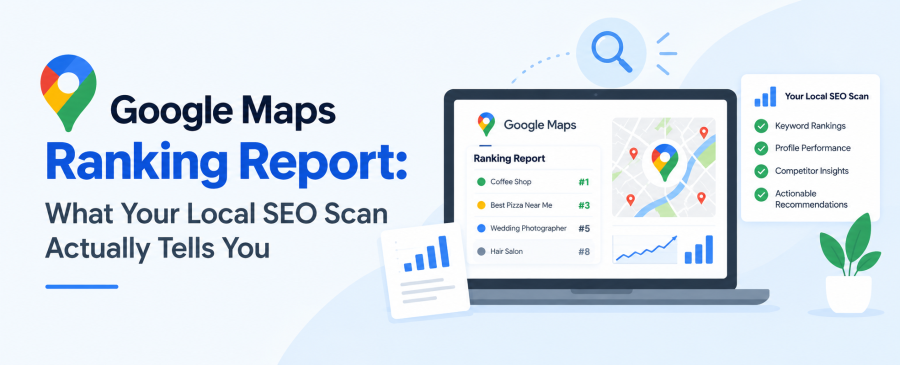
You ran a scan. Now you’re staring at a screen full of numbers, checkmarks, and red flags, wondering what any of it actually means for your business. That’s the most common question we get at Map Ranks, and it’s a fair one.
A Google Maps ranking report and local SEO audit aren’t just scorecards. It’s a map of exactly where your Google Business Profile is losing customers to competitors down the street. In this guide, we’ll break down what a real Google Business Profile audit covers, how to read it without a marketing degree, and how to turn those findings into more calls and foot traffic. We’ll also show you a real case study so you can see what this looks like in practice, not just in theory.
Key Takeaways
- A local SEO scan checks proximity, category accuracy, review velocity, photos, posts, and NAP consistency, not just your star rating.
- Ranking gaps usually come down to three things: incomplete profile data, weak review activity, and missing service area coverage.
- A proper local SEO report compares your listing directly against the businesses currently outranking you.
- Many businesses can begin seeing measurable changes within 30 to 90 days after implementing recommended fixes, although results vary by market and competition.
- Real client data (like our Mathnasium and CoolVu case studies) shows what consistent optimization does to calls, direction requests, and website visits.
How Can You Identify Ranking Gaps and Competitors From a Google Maps Report?
A Google Maps ranking report helps you identify where competitors are outperforming your business. Compare factors such as review activity, categories, proximity, profile completeness, photos, posts, and service areas to find the gaps affecting your local visibility.
What Is a Local SEO Audit Report, Exactly?
A local SEO audit report is a detailed breakdown of how your Google Business Profile performs against local competitors on Google Maps. It goes beyond a simple “yes, you’re listed” check and digs into the specific signals Google uses to decide who shows up in the Map Pack.
Think of it less like a report card and more like a diagnostic. A doctor doesn’t just tell you that you’re sick. They tell you why and what to do about it. Our team built the Free Listing Scan the same way. We’re not handing you a number and walking away. We’re showing you the actual gaps.
Here’s what a solid audit typically covers:
- Proximity signals – how close your listing appears to be to the searcher
- Category accuracy – whether Google has you filed under the right primary and secondary categories
- Review velocity – how fast you’re earning reviews compared to competitors
- Photo and post activity – how often you’re adding fresh content
- Service area setup – whether you’re capturing searches from nearby zip codes
- NAP consistency – matching name, address, and phone number across directories
If your report doesn’t cover these areas, it may be more of a basic listing scan than a comprehensive local SEO audit.
How to Check Your Google Maps Ranking Report
To check your Google Maps ranking report, run a live scan that pulls your current profile data and compares it against the top-ranking competitors in your service area. You can do this manually by searching your target keywords in incognito mode from different locations or use a dedicated audit tool that automates the comparison.
Manual checking has a problem, though. Google personalizes results based on your search history, your device, and your exact location. What you see when you search your own business isn’t what a customer three miles away sees. That’s why we built our scan to simulate multiple searcher locations at once, not just one.
Here’s the process our team follows when running a local SEO scan for a client:
- Pull the business’s current Google Business Profile data
- Identify the top three to five competitors ranking for the target keywords
- Compare category selection, review count, review response rate, and photo volume
- Check proximity performance across a radius, not a single point
- Flag any NAP inconsistencies across major directories like Bing, Apple Maps, and Yelp
- Package the findings into a plain-English action plan
The scan itself takes about five minutes on our end. Reading it and knowing what to prioritize, that’s where most business owners get stuck. That’s normal. This is genuinely complex, and it changes as Google updates its algorithm.
How to Identify Ranking Gaps and Competitors From a Google Maps Report
Ranking gaps show up when your report highlights specific categories where a competitor outperforms you, such as more recent reviews, better category selection, or stronger proximity coverage. The report should name the competitors directly, not just show your score in isolation.
A number without context is useless. If your report says you’re “70% optimized,” that tells you nothing. What matters is 70% compared to who?
Here’s what we look for when spotting gaps:
Review gap. If a competitor has 40 reviews from the last 90 days and you have 3, that’s a velocity gap. Google weighs recent activity heavily, not just your total count.
Category gap. Many businesses pick one broad category and stop there. A plumber who only selects “Plumber” and skips “Drain Cleaning Service” or “Water Heater Repair” is invisible for those specific searches.
Proximity gap. This one surprises people. You might rank #1 at your exact address and disappear three zip codes over. That’s a proximity blind spot, and it usually means your service area isn’t configured correctly.
Content gap. Competitors posting weekly updates and fresh photos tend to outrank profiles that haven’t been touched in six months. Google reads that inactivity as a weaker signal.
Once you know which gap is dragging you down, the fix is usually specific and fast. Vague reports lead to vague fixes. Specific reports lead to real movement.
How a Google Maps Ranking Report Improves Local SEO Performance
A Google Maps ranking report improves local SEO performance by turning guesswork into a prioritized action list, so you fix the highest-impact issues first instead of randomly tweaking your profile. Most business owners waste time on things that barely move the needle, like changing their business description repeatedly, while ignoring review response rates that actually matter.
We’ve seen this play out across dozens of accounts. A business owner spends hours polishing photos while their listing sits in the wrong category. The report catches that in seconds.
There’s also a bigger shift happening in search right now worth understanding. Search engines and AI assistants are increasingly answering questions directly, a trend often called AEO, GEO, and AIO (Answer Engine Optimization, Generative Engine Optimization, and AI Optimization). Your Google Business Profile and other consistent business information can help search systems better understand and represent your business. A clean, complete, accurate profile isn’t just good for ranking anymore. It’s good for how AI represents you across the web.
This is also where E-E-A-T (Experience, Expertise, Authoritativeness, and Trustworthiness) comes into play. Google increasingly rewards profiles that demonstrate real-world proof: verified reviews, consistent business information, active engagement, and a track record customers can see. A ranking report is really just a checklist for E-E-A-T signals specific to Google Maps.
Case Study: What a Real Local SEO Audit Leads To
We don’t just talk about results. We track them, quarter over quarter, for every client. Take Mathnasium, an after-school math tutoring franchise we’ve worked with across multiple locations.
After we ran audits across their profiles and fixed the gaps we found (category accuracy, review response consistency, and posting frequency), the results showed up in the numbers. Between Q3 2025 and Q1 2026, Mathnasium’s network saw website visits grow to 9,259, phone calls jump to 13,558 (a 68.6% increase), and direction requests climb to 31,964 (up 20.5%).
We saw a similar pattern with CoolVu, a window film and surface solutions franchise. After we cleaned up their listing data and built out a consistent optimization schedule, phone calls jumped over 1,200% quarter over quarter, and total listing views grew by more than 1,290%.
These aren’t outliers. They’re what happens when a proper audit gets followed by proper execution. You can see the full breakdown, including Dogtopia’s 250-location rollout and Tint World’s 150-location expansion, on our case studies page. If you’re ready to improve your own local visibility, contact our team to discuss your next steps.
What to Do After You Get Your Report
Getting the report is step one. Acting on it is where the results actually happen. Here’s how we recommend prioritizing:
- Fix category errors first. This is the fastest change with the biggest impact.
- Respond to every open review. Google tracks response rate, and so do customers reading your profile.
- Add photos weekly, not monthly. Fresh content signals an active, trustworthy business.
- Confirm your service area matches where customers actually search. Don’t guess. Check the report’s proximity data.
- Clean up directory listings. Mismatched addresses on Yelp, Bing, or Apple Maps quietly hurt your Google ranking too.
If some of these fixes are simple, do them yourself. That’s honestly fine, and we’ll tell you as much. If you’d rather have a team handle the ongoing management (weekly posts, review responses, citation cleanup, and monthly reporting), that’s where our local SEO services come in.
For context on how Google itself describes ranking factors, Google’s own guidance on how business profiles rank on Google Maps is worth a read alongside your report.
Ready to see where your business actually stands? Run your free listing scan to see what’s holding your Google Maps ranking back. It takes just five minutes to get a clear picture of your local SEO performance and the areas you can improve.
Frequently Asked Questions
How do I check my Google Maps ranking report?
Run a live scan comparing your Google Business Profile against your top local competitors, or request a free audit from a team that manually reviews the data instead of just running an automated score.
What’s the difference between a local SEO scan and a full audit?
A scan usually gives you a quick score, while a full audit explains why that score exists and names the specific competitors and gaps causing it. Always ask what’s behind the number.
How often should I request a local SEO report?
Every 60 to 90 days is a reasonable cadence for most local businesses, since Google’s algorithm and your competitors’ activity both shift over that window.
Can a Google Business Profile audit help if I have multiple locations?
Yes, though each location needs its own audit since proximity, competitors, and category performance vary by address, even within the same city.
Does fixing my ranking report guarantee the top spot?
No audit can promise a #1 ranking, since Google’s algorithm weighs dozens of signals and competitor activity changes constantly. What a good audit does is identify the specific fixes most likely to move you up.
Is a local SEO audit report free?
Many agencies, including ours, offer a free initial scan with no credit card or obligation. Paid, ongoing audits typically come with ongoing management and ranking updates.

Map Ranks is a local SEO agency that helps businesses get found fast on Google Maps and local pack. Our team specializes in Google Maps Marketing, SEO, and optimization strategies designed to boost your visibility, attract nearby customers, and grow your local presence. We make sure your local business stands out right where it matters; on the map and in front of the people searching for you.