

How to Build Local Authority for Google Maps & AI Search
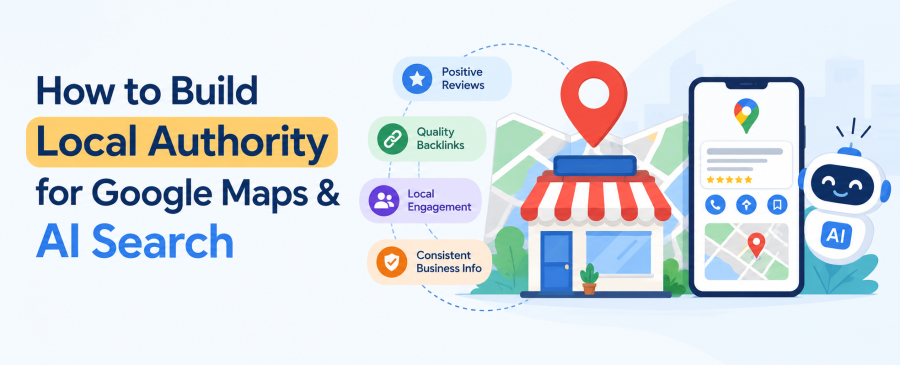
A client asked us last month why their newest competitor, open for barely a year, kept showing up above them on Google Maps and getting name-dropped in an AI Overview answer. Their own listing was older, their reviews were fine, and nothing had technically gone wrong. What changed was that the competitor had quietly built more authority, faster.
That’s the piece most business owners miss right now. Ranking well used to mean chasing keywords. Today it means proving to Google Maps and to AI systems, through AEO (Answer Engine Optimization), GEO (Generative Engine Optimization), and AIO (AI Optimization), that your business is the credible, current answer to a customer’s question. We manage Google Business Profiles for franchise networks and independent local businesses at Map Ranks, so we watch this play out on real accounts every week, not in theory.
This guide walks through what local authority actually is, the specific signals that build it, and why the work that lifts your Google Maps ranking is largely the same work that gets your business cited by AI search tools like Google AI Overviews, ChatGPT, and Perplexity.
Key Takeaways
- Local authority is built through consistency, reviews, verified information, and real engagement, not shortcuts.
- Google Maps and AI search engines pull from overlapping trust signals, so one strong local SEO strategy supports both.
- Review volume, review responses, and structured business data are among the strongest authority signals right now.
- AI search tools favor businesses with clean, consistent data across the web and detailed, specific content.
- Local authority building is an ongoing process, not a one-time fix.
What Does “Local Authority” Actually Mean?
Local authority is the level of trust Google and AI search engines place in your business as a credible, established, relevant option for a specific location and service. It’s earned through consistent signals over time, not built overnight.
Think of it like a reputation you build in your own neighborhood. If ten different people tell a new resident, “Go to that shop; they’re reliable,” that shop has authority. Google Maps and AI engines are doing something similar. They’re pulling in reviews, citations, engagement data, and content to decide who deserves the recommendation.
A business with strong local authority typically has:
- A fully completed and accurate Google Business Profile
- A steady stream of recent, detailed customer reviews
- Consistent name, address, and phone number (NAP) data across the web
- Location-specific content that answers real customer questions
- Active engagement, meaning posts, photo updates, and review responses
How to Build Local Authority for Google Maps Ranking
Your Google Business Profile is only one part of local authority. To build stronger visibility in Google Maps and AI search, your business also needs supporting signals across the wider web. Search engines can use information from your website, local directories, industry publications, community websites, and other trusted sources to understand how relevant and established your business is.
Instead of focusing only on profile activity, strengthen the signals surrounding your business:
- Build relevant local citations. Make sure your business is listed accurately on reputable local, industry, and niche directories that are relevant to your location and services.
- Earn local and industry backlinks. Get mentioned by credible local publications, associations, chambers of commerce, community organizations, and industry websites. Relevant mentions can strengthen your business’s overall online authority.
- Create location-specific content. Publish useful pages and resources that answer questions customers in your service area actually search for. Focus on genuine local expertise rather than simply adding city names to existing content.
- Strengthen entity consistency across the web. Keep your business name, services, locations, contact information, and other important details consistent across your website and third-party platforms.
- Build topical authority around your services. Create detailed service pages, supporting resources, FAQs, and educational content that demonstrate expertise in what your business actually offers.
- Earn genuine local mentions. Partnerships, sponsorships, community involvement, local events, and industry relationships can create real-world connections that lead to valuable online mentions and references.
If this feels like a lot to manage on your own, this is exactly what our Google Maps Optimization service handles for clients day to day. We treat the profile as a living asset, not a one-time setup.
How Does Local Authority Impact AI Search Visibility?
AI search tools cite businesses that already have strong, verifiable authority signals across the web, so the same trust-building work that helps Google Maps ranking also helps you get mentioned by AI. Generative engines don’t invent recommendations from nothing. They pull from existing, verified data.
Here’s what’s actually happening behind the scenes. AI search systems can draw on information from websites, business profiles, reviews, directories, and other publicly available sources when generating local recommendations or answers. If your information is thin, inconsistent, or outdated, AI models simply have less reason to trust it.
This is why AEO and GEO matter so much right now. AEO focuses on structuring your content so it directly answers specific questions, the exact way an AI would want to quote it. GEO goes further, optimizing your overall web presence so generative engines see your business as a credible source across multiple platforms, not just one page.
AIO ties both together. It treats your entire online footprint, your website, your Google Business Profile, your reviews, and your citations as one signal set that AI models evaluate together.
What Signals Help Build Trust for Local Businesses in Google Maps & AI Search?
The signals that build trust for both systems overlap more than most business owners realize, and they center on consistency, credibility, and real engagement. Here’s a breakdown of the ones we see move the needle most often:
- Review quantity and quality. Recent, detailed reviews mentioning specific services carry more weight than generic five-star ratings.
- Business information consistency. Matching NAP data across directories, your website, and social platforms.
- Structured data (schema markup). Helps both search engines and AI tools understand exactly what your business offers.
- Content depth. Pages and blog posts that fully answer a customer question, not thin, generic pages.
- Citations from reputable directories. Being listed accurately on relevant, trusted industry and local directories.
- Engagement signals. Photo uploads, Q&A activity, and post frequency on your Google Business Profile.
- Backlinks and mentions. Being referenced by other credible local or industry websites.
According to Google’s own Business Profile guidance on ranking, relevance, distance, and prominence are the three core ranking factors, and prominence is built almost entirely through the authority signals listed above.
How to Improve Local SEO Authority for Both Maps and AI-Driven Search Results
The fastest way to improve authority across both channels is to treat your Google Business Profile, your website, and your citations as one connected system instead of separate projects. Most businesses handle these in silos, which is exactly why their signals look inconsistent to search engines.
A few practical steps that work well together:
- Audit your NAP consistency across your top 20 directory listings.
- Add FAQ content to your key pages that directly answers customer questions in plain language.
- Build a review generation habit, asking every satisfied customer at the point of service.
- Make sure your website and Google Business Profile use matching, specific service descriptions.
- Work with a team that understands both traditional local SEO and how AI engines evaluate businesses.
This is the exact gap our local SEO services close for clients. We don’t just optimize a listing; we build the full authority profile that both Google Maps and AI search engines are actually looking for. If you want more background on how ranking factors work day to day, our guide on Google Maps ranking breaks it down further.
Real Results: A Quick Case Study
Talk is easy. Numbers are harder to fake. When we took on Dogtopia’s 250+ franchise locations, the goal was consistent authority at scale, not a quick fix for one location.
By fully optimizing every Google Business Profile, keeping data consistent across all locations, and maintaining active engagement, Dogtopia’s network grew website visitors from 449,475 to 529,919 year over year, a 17.9% increase, along with a 22.4% jump in direction requests and a 26.1% increase in phone calls. That’s what compounding local authority looks like when it’s managed properly across many locations at once.
You can see this case study and others, including Mathnasium and Tint World, on our case studies page.
Ready to strengthen your local authority? Contact Map Ranks to discuss your Google Maps and local SEO strategy, identify ranking gaps, and improve your local search visibility. Get in touch with our team today.
Frequently Asked Questions
How long does it take to build local authority?
Most businesses start seeing measurable movement within 60 to 90 days, though full authority building is an ongoing process rather than a fixed timeline.
Does local authority matter if I only have one location?
Yes. Single-location businesses actually benefit faster since there’s less data to keep consistent, and focused effort shows results sooner.
Can AI search tools recommend my business if I’m not ranking well on Google?
It’s possible but less likely. AI engines lean heavily on the same trust signals Google uses, so weak local SEO usually means weaker AI visibility too.
Do I need a separate strategy for AI search versus Google Maps?
No. The core work, consistent data, strong reviews, and detailed content support both. The difference is in how you structure and present that information.
What’s the single biggest authority signal right now?
There isn’t one single authority signal. Consistent business information, relevance, prominence, quality reviews, reputable citations, and strong local content all contribute to a business’s overall authority.

Map Ranks is a local SEO agency that helps businesses get found fast on Google Maps and local pack. Our team specializes in Google Maps Marketing, SEO, and optimization strategies designed to boost your visibility, attract nearby customers, and grow your local presence. We make sure your local business stands out right where it matters; on the map and in front of the people searching for you.