

How to Rank in AI Search Results and Google Maps at the Same Time
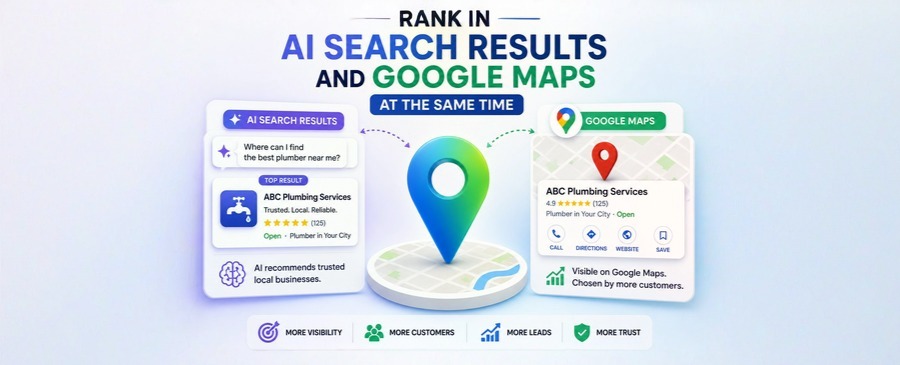
Search has split into two tracks. There’s the traditional Google Maps pack that local businesses have relied on for years. And now there’s a growing layer of AI search results powered by tools like ChatGPT, Google’s AI Overviews, Perplexity, and Gemini.
Here’s the thing: you can win both. They share more common ground than most people realize. At Map Ranks, we’ve worked with local businesses to build strategies that improve visibility in AI-generated answers AND the Google Maps pack at the same time. This guide breaks down exactly how.
Key Takeaways
- AI search tools and Google Maps pull from the same trust signals: accurate data, strong reviews, and authoritative content.
- Optimizing your Google Business Profile is still one of the highest-ROI moves you can make in 2025.
- Structured, question-answer content dramatically improves your chances of appearing in AI Overviews and ChatGPT answers.
- Local SEO for AI search is not a separate strategy. It builds directly on what you’re already doing for Maps.
- Consistent NAP (Name, Address, Phone) across the web is a foundational ranking signal for both channels.
Why AI Search and Google Maps Are More Aligned Than You Think
Both AI engines and Google Maps are trying to solve the same problem: find the most trustworthy, relevant local business for a given query. They just surface answers differently.
Google’s AI Overviews pull heavily from Google’s own index, which includes your Business Profile data, local citations, and website content. ChatGPT and Perplexity crawl the web and prioritize sources that show authority, consistency, and helpfulness.
What that means for you is simple. A well-optimized local presence feeds both systems. You’re not maintaining two separate strategies. You’re building one strong foundation that works across channels.
Google Business Profile Ranking Factors That Also Help AI Search
Your Google Business Profile (GBP) is one of the most powerful tools in local search. Most businesses don’t fully use it. Here are the key Google Business Profile ranking factors to focus on and why they matter for AI search too:
- Complete and accurate profile: Name, address, phone number, hours, website, and category must all be filled in and correct. AI engines verify business details against multiple sources. Inconsistencies hurt you.
- Primary and secondary categories: Pick your most specific primary category. AI systems use this to match businesses to queries precisely.
- Photos and updates: Businesses with regular photo uploads and Google Posts get higher engagement signals. Those engagement signals feed into ranking algorithms.
- Review quantity and quality: Reviews are one of the biggest trust signals for both Maps and AI. More reviews, higher ratings, and detailed content all help. Responding to every review shows engagement.
We cover advanced GBP strategies on the Map Ranks blog. The short version: treat your profile like a living document, not a set-it-and-forget-it listing.
How AI Search Optimization Works for Local Businesses
AI search optimization means structuring your content and online presence so AI engines can understand, trust, and cite you. It’s not magic. It’s mostly about clarity and consistency.
Here’s what matters most:
- Direct answers to direct questions: AI Overviews and ChatGPT favor content that answers questions concisely at the top of a page or section. If someone asks, “What’s the best HVAC company in Dallas?” a page that immediately says who you are, where you serve, and what makes you reliable is more likely to get pulled.
- Structured data (schema markup): Schema helps AI engines categorize your content faster. LocalBusiness schema, FAQPage schema, and Review schema are the three you need as a local business.
- Citations and mentions: AI tools measure your authority partly by how often you’re mentioned across the web. Consistent, positive mentions from directories, news sites, and industry platforms all contribute.
- Entity clarity: AI engines build a mental model of your business as an “entity.” Clear, consistent branding, location data, and service descriptions across every platform help your entity get recognized quickly.
Local SEO for AI Search: The Practical Steps
This is where many guides get vague. We’re going to be specific. Here’s what local SEO for AI search looks like in practice:
Step 1: Lock Down Your NAP Consistency
Your business name, address, and phone number must match exactly across Google, Yelp, Facebook, Apple Maps, and every directory listing. Even small differences (“St.” vs. “Street”) create confusion for AI crawlers.
Run a citation audit. Fix the inconsistencies. This is foundational. Nothing else works as well until this is clean. Our team at Map Ranks includes citation auditing as part of every local SEO engagement.
Step 2: Build Content That Answers Real Questions
Think about the questions your customers actually ask before calling you. Write clear, direct answers to each one on your website. FAQ pages are great. So are service pages that include a “common questions” section.
The goal is to be the clearest, most direct answer available for your service area and service type. AI engines are looking for confidence, not creativity.
Step 3: Earn and Manage Reviews Actively
Reviews are trust signals for both Google Maps and AI. A business with 200 positive reviews is more likely to appear in an AI-generated answer than one with 12 reviews, all else being equal.
Build a review request process into your business operations. Ask every happy customer. Make it easy with a direct link. Respond to every review you get, good or bad.
Step 4: Use Schema Markup on Your Website
Schema markup is code that tells search engines exactly what your content means. For local businesses, the essentials are:
- LocalBusiness schema with your full address, hours, and service area
- FAQPage schema on any page with questions and answers
- Review/AggregateRating schema to surface your review score
- BreadcrumbList schema for clear site structure
If you need help implementing schema, our local SEO services include full structured data setup.
Step 5: Keep Your Google Business Profile Active
Post updates weekly. Add new photos monthly. Respond to every review within 48 hours. Answer questions in the Q&A section. Update your hours for holidays immediately.
Activity signals freshness. Freshness is a ranking factor. This is true for both Maps and AI Overviews.
Google Maps Marketing: What’s Actually Working Right Now
Google Maps marketing isn’t just about getting into the local 3-pack anymore. With AI Overviews now appearing above the map pack on many queries, the stakes are higher.
Here’s what’s working in Google Maps marketing today:
- Proximity still matters, but authority can offset it. A business with strong reviews and an optimized profile can outrank closer competitors.
- Services added to your GBP help match you to more specific queries. Don’t just list “plumber.” List every specific service you offer: water heater installation, drain cleaning, emergency plumbing, etc.
- Local backlinks (links from local news sites, chambers of commerce, and local blogs) still have a strong impact on map rankings.
- Google’s “justifications” (the snippets that appear under business names in Maps) are pulled from reviews and your website. Write your site copy with that in mind.
Want a deeper look? Read our guide to Google Maps ranking strategies on the Map Ranks blog.
The Content Stack That Works for Both Channels
You don’t need to produce enormous amounts of content. You need the right content, well organized. Here’s the content stack we recommend for local businesses targeting both AI and Maps:
- Homepage: Clear service description, location served, trust signals (years in business, certifications, review count), and a direct value statement in the first 100 words.
- Service pages: One page per core service. Each page answers the questions: What is this service? Who needs it? What does it cost? Why should they choose you? And what’s the service area?
- Location pages: If you serve multiple cities or neighborhoods, build dedicated location pages. Keep them genuinely useful, not duplicate filler.
- FAQ page: Minimum 10 questions. Real questions from real customers. Short, direct answers.
- Blog: Publish one helpful article per month. Focus on questions your customers ask. Internally link to your service pages.
How to Track Your AI Search Visibility
This is harder than tracking traditional rankings, but it’s not impossible. Here’s how we approach it:
- Manual spot checks: Run your target queries in ChatGPT, Perplexity, and Google with AI Overviews enabled. Note when your business appears, when competitors appear, and what sources are being cited.
- Google Search Console: Monitor your AI Overview impressions. GSC now shows impressions from AI Overviews for many accounts.
- GBP Insights: Track search views, map views, calls, and direction requests monthly. Trending up means your visibility is improving.
- Review velocity: Track how many new reviews you get each month. This is a leading indicator of trust signal strength.
Tracking AI search visibility is an evolving practice. We write about measurement strategies regularly at Map Ranks.
Frequently Asked Questions
What is AI search optimization for local businesses?
AI search optimization means structuring your content, business data, and online presence so that AI tools like ChatGPT, Google AI Overviews, and Perplexity can identify, trust, and cite your business in responses to relevant queries. For local businesses, it focuses on accurate business data, helpful content, strong reviews, and clear entity signals across the web.
Does optimizing for Google Maps also help with AI search?
Yes, significantly. Both Google Maps and AI search tools prioritize the same core signals: accurate and consistent business information, strong reviews, relevant content, and citation authority. Improving your Google Business Profile and building a solid local SEO foundation directly feeds both channels.
How long does it take to rank in AI search results?
There’s no fixed timeline, but businesses with complete profiles, consistent citations, 50+ recent reviews, and well-structured website content typically start seeing AI search visibility within 3 to 6 months of active optimization. Competitive markets take longer.
What are the most important Google Business Profile ranking factors?
The most important factors are accurate and complete profile information, review quantity and quality, engagement activity (photos, posts, and Q&A), relevance of the primary category, and proximity to the searcher. Review response rate and profile completeness have grown in importance recently.
Can a small business compete in AI search results against larger brands?
Yes. AI search tools often favor local authority over pure domain authority. A well-reviewed, well-cited local business with clear, helpful content can appear in AI-generated answers even when competing against larger brands with bigger budgets. Local relevance and trust signals are the equalizers.
What is local SEO for AI search?
Local SEO for AI search is the practice of optimizing your local online presence specifically to appear in AI-generated responses to location-based queries. It includes NAP consistency, Google Business Profile optimization, schema markup, review management, and creating content that directly answers the questions your local customers ask.

Map Ranks is a local SEO agency that helps businesses get found fast on Google Maps and local pack. Our team specializes in Google Maps Marketing, SEO, and optimization strategies designed to boost your visibility, attract nearby customers, and grow your local presence. We make sure your local business stands out right where it matters; on the map and in front of the people searching for you.