

Why AI Citations Are the New Backlinks in Google Maps Marketing
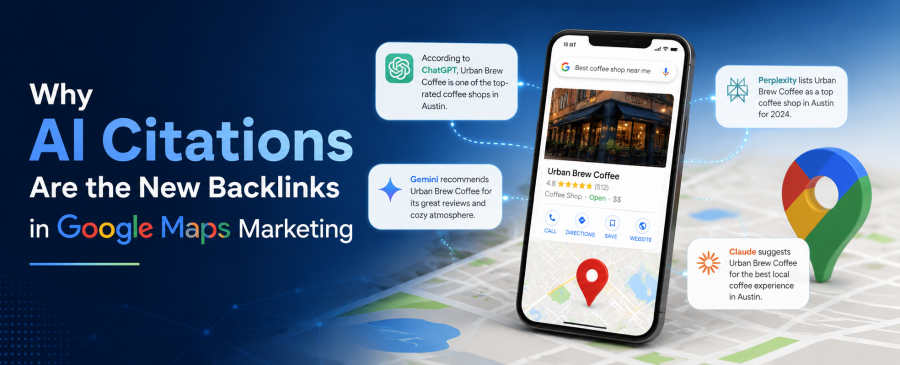
Ten years ago, backlinks were the currency of trust online. If a big site linked to you, Google noticed. That game hasn’t disappeared, but after managing Google Maps Marketing campaigns for local businesses across the country, we’ve watched a new competitor emerge in real time.
AI search tools like Google’s AI Overviews, ChatGPT, and Perplexity now decide which local businesses get mentioned by name and which get skipped entirely. This shift changes how we plan every strategy now, and it should change how you think about local visibility too. This is where AEO, GEO, and AIO come in, and they all lean on one thing: AI citations.
If you’re a local business owner, this isn’t a future problem. It’s a right-now problem, and it’s tied directly to how you rank higher on Google Maps.
AI citations are direct mentions of your business by tools like ChatGPT, Perplexity, and Google AI Overviews when answering user queries. They now influence local visibility as much as traditional backlinks do, and businesses that structure their content, schema markup, and Google Business Profile correctly are the ones getting cited.
Key Takeaways
- AI citations are mentions of your business by AI tools in direct answers, similar to how backlinks work for traditional SEO.
- AI search optimization now influences local visibility as much as classic ranking factors do.
- Google Maps marketing success depends on structured data, reviews, and consistent NAP details.
- Businesses with strong AI search visibility get recommended more often in voice search and chat-based search.
- Schema markup, FAQs, and authoritative content help AI engines trust and cite your business.
What Are AI Citations, Exactly?
AI citations are the specific mentions an AI tool makes of your business, product, or service when answering a user’s question. Think of it as the AI quoting you as the answer, not just linking to you.
When someone asks ChatGPT “which plumber near me has the best reviews,” the tool doesn’t hand back ten blue links. It picks one or two names and explains why. That explanation, that direct mention, is an AI citation.
We started tracking this pattern last year for a handful of clients. The businesses getting picked weren’t always the biggest names in their city. They were the ones with clean, structured information the AI could actually parse and trust.
Why AI Citations Work Like Backlinks Now
A short answer: backlinks told Google, “this site is trusted by others.” Today, AI-generated references tell AI models, “this business is the best answer to this question.” Both act as trust signals, but they work through different systems.
Backlinks have long worked like votes. When an authoritative website links to another, it helps build domain authority over time. AI mentions and references work in a similar way, except the “vote” happens within an AI-generated response rather than through a traditional hyperlink.
Here’s the practical difference we see with clients:
- Backlinks build authority gradually through months of outreach and content marketing.
- AI-generated mentions can appear much faster when your business information is well-structured and consistently published across trusted sources.
- Backlinks help search engines discover, crawl, and rank web pages.
- AI-powered references help large language models recognize your business as the most relevant answer for a user’s question.
Whether it’s backlinks or AI-driven business mentions, both rely on the same core principle: earning genuine trust through accurate, authoritative, and consistent information.
This is why we tell clients that Google Maps Marketing today needs both approaches running together, not one replacing the other.
How AI Search Optimization Changes Local SEO Strategy
AI search optimization means structuring your online presence so AI tools can read, verify, and confidently cite your business. It’s less about keyword stuffing and much more about clarity.
We’ve noticed three things AI models consistently reward:
- Structured data (schema markup) on your website and blog pages
- Consistent NAP information (Name, address, and Phone) across every listing
- Content that answers questions directly, in plain language, near the top of the page
If your website buries the answer under five paragraphs of fluff, the AI moves on to a competitor who didn’t. That’s not opinion; that’s what we’ve watched happen across dozens of local business audits.
Our team at Map Ranks builds this structure into every Google Business Profile optimization we run, because the same clean data that helps a profile rank also helps an AI engine cite it correctly.
What Drives AI Search Visibility for Local Businesses?
AI search visibility comes down to how easily an AI model can confirm your business is real, active, and reputable. Reviews, structured data, and consistent citations across the web all feed into that confirmation.
A few factors we’ve seen move the needle the most:
- Review volume and recency. AI models weigh recent reviews more heavily than old ones.
- Business description clarity. Vague descriptions get skipped over for specific, service-focused ones.
- Category accuracy on your Google Business Profile. Wrong categories confuse both Google Maps and AI crawlers.
- Consistent citations across directories. This overlaps with traditional backlinks for local SEO, and it still matters.
- Structured FAQ content. AI tools pull directly from well-formatted question-and-answer sections.
Think about how a patient chooses a doctor before surgery. They don’t just pick the first name they see. They check reviews, verify credentials, read about the doctor’s experience with that specific treatment, and look for proof the outcomes were good. AI models are doing something close to that same background check on your business before they’ll recommend you. Skip the verification, and you don’t get picked, no matter how good your service actually is. To understand exactly how Google’s AI evaluates and ranks local businesses in 2026, our guide on how Google’s AI is changing local search breaks down what’s shifting and what it means for your visibility.
Building AI Citations Through Structured Content
The clearest path to more AI citations is publishing content that directly answers real questions, backed by schema markup that helps machines read it correctly. This is the same principle behind AEO and GEO.
Here’s a simple checklist we follow on every blog and service page we manage:
- Add FAQ sections with direct, short answers
- Mark up FAQs with FAQ schema so AI tools can parse the Q&A format instantly
- Include author bios with real credentials, not generic “admin” bylines
- Link internally between related service pages and blog posts
- Keep meta titles and descriptions focused on the actual question being answered
We’ve applied this exact framework across client sites and watched their mentions in AI-generated answers grow within weeks, not months. It’s not magic. It’s just giving the AI clean information to work with.
Rank Higher on Google Maps With Both Old and New Signals
You still need the fundamentals. Complete your Google Business Profile. Get real reviews. Keep your hours accurate. Our Google Maps ranking services handle exactly this kind of foundational work every day.
But layering AI search optimization on top of that foundation is what separates businesses that show up in 2026 from ones stuck relying on tactics from 2019. According to Google’s own documentation on structured data, marked-up content helps search systems understand context more precisely, which is exactly the kind of clarity AI citation engines need too.
If you’re planning a broader local SEO push, our guide on how our process works breaks down where citations, reviews, and profile data all fit together.
Frequently Asked Questions
What are AI citations in simple terms?
AI citations are direct mentions of your business by an AI tool when it answers a user’s search query. They work similarly to backlinks but live inside generated answers instead of web pages.
Are AI-generated references replacing backlinks completely?
No. Backlinks still play an important role in traditional search rankings. However, AI mentions and AI search references add another layer of visibility by helping AI tools recognize and recommend your business when answering user queries.
How do I know if my business is getting AI citations?
Search common questions related to your industry and location on tools like ChatGPT or Google’s AI Overviews. If your business name appears in the answer, that’s an active citation.
Does Google Maps marketing need a different strategy for AI search?
It needs an expanded strategy. The core work, like profile completion and reviews, stays the same. AI search optimization adds structured data and clearer content on top of that base.
How long does it take to see results from AI search optimization?
Some businesses see mentions appear within a few weeks of adding schema and FAQ content. Full local rankings, both on Maps and in AI answers, typically strengthen over two to three months.
Is AI citation optimization only for large businesses?
No. In fact, smaller local businesses often see faster results because they serve a specific geographic area where competition for AI citations is lower. A well-structured Google Business Profile and one or two FAQ-rich blog posts can be enough to start appearing in local AI-generated answers.

Map Ranks is a local SEO agency that helps businesses get found fast on Google Maps and local pack. Our team specializes in Google Maps Marketing, SEO, and optimization strategies designed to boost your visibility, attract nearby customers, and grow your local presence. We make sure your local business stands out right where it matters; on the map and in front of the people searching for you.