

How SEO Elevates Your Local Business Visibility
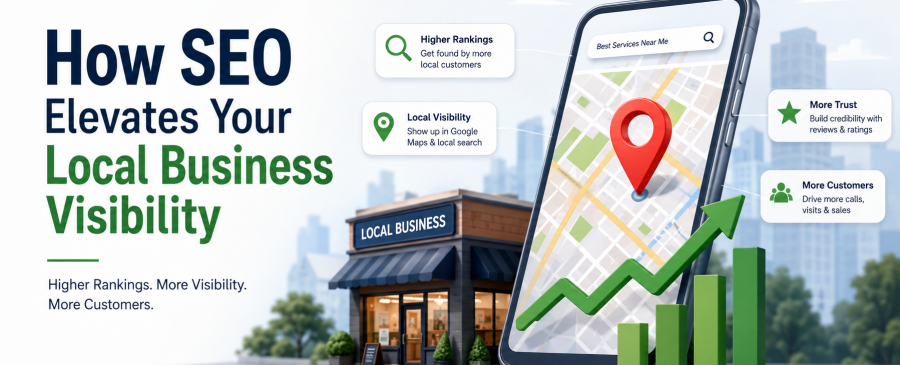
Most small business owners assume a website is enough. It isn’t. We have watched plumbers, dentists, and HVAC contractors with beautiful websites sit on page three of Google while a competitor with a plain site takes every phone call in town. The difference almost always comes down to one thing: local business visibility.
Over the past several years, our team has audited and optimized Google Business Profiles for businesses across industries, including plumbing, HVAC, legal, dental, roofing, and medical practices. While every market is different, the same ranking patterns appear repeatedly:
- Incomplete Google Business Profiles rarely reach the Maps 3-Pack.
- Businesses earning reviews consistently outperform competitors with higher domain authority.
- Location-specific service pages almost always outperform generic service pages.
Key Takeaways
- Local business visibility depends on Google Business Profile strength, citations, reviews, and content, not just a website.
- 93% of consumers read online reviews before choosing a business, so review management is now a ranking and conversion factor.
- AI tools like ChatGPT are becoming a real recommendation source, with usage jumping from 6% to 45% of consumers in a single year.
- Local SEO services typically show measurable ranking movement within 60 to 90 days when done consistently.
- Local SEO is possible, but most businesses lack the time to manage citations, reviews, and content every month.
What Is Local Business Visibility, Exactly?
Local business visibility is how easily nearby customers can find your business when they search for what you offer. It shows up in three places: the Google Maps 3-pack, organic local search results, and increasingly, AI-generated answers.
If your business only appears when someone types your exact name, you don’t have visibility. Real visibility means showing up for “plumber near me” or “best dentist in [city]” without the customer ever having heard of you before.
This is different from brand awareness. A business can be well known locally and still be invisible online, especially if the Google Business Profile is thin or the website has no location-specific content.
According to Google, searches containing phrases like “near me” continue to grow, reflecting how consumers increasingly rely on local intent searches before making purchasing decisions.
Why Local Business Visibility Matters More Than It Used To
Search habits changed fast. People don’t flip through the phone book, and they barely scroll past the first few results either.
Here’s what the data tells us:
- Most local searchers pick a business from the Google Maps 3-pack and never scroll further.
- According to BrightLocal’s 2026 Local Consumer Review Survey, 93% of consumers read reviews before visiting a business, and use of AI tools like ChatGPT for local recommendations jumped from 6% to 45% year over year.
- A weak or incomplete Google Business Profile pushes you below competitors who update theirs regularly.
That AI number matters a lot. If AI assistants are now a meaningful source of local recommendations, businesses that ignore this shift are quietly losing customers they never even knew were searching.
This is exactly the gap that dedicated local SEO services are built to close, since staying visible across Maps, organic results, and AI answers takes ongoing work, not a one-time setup.
How Local SEO Actually Builds Visibility
Local SEO isn’t one task. It’s a stack of smaller efforts that compound over months. Here’s what actually moves rankings, based on what we manage for clients:
- Google Business Profile optimization. Categories, services, photos, and business descriptions all need to be filled out completely and kept current.
- Citation consistency. Your business name, address, and phone number need to match exactly across every directory. Mismatched data confuses Google and hurts trust signals.
- Review generation and response. Volume, recency, and how you respond to reviews all factor into rankings and customer decisions.
- Location-specific content. Pages built around each city or service area you cover, written for actual humans first.
- Local backlinks. Links from community sites, local news, and industry directories carry real authority in your market.
None of these work in isolation. A business with perfect citations but zero reviews will still lose to a competitor doing both well. This is exactly the kind of work a dedicated local SEO company builds a process around, because managing five moving pieces every month is hard to sustain solo.
How to Get Featured in AI Overviews (AIO)
Getting your business recommended by AI tools like ChatGPT or Google’s AI Overviews isn’t magic; it comes down to how easily these machines can read and understand your data. AI engines are essentially scraping the web for the clearest, most authoritative answers to user questions.
If you want to show up when someone asks an AI, “Who is the best plumber near me?”, you need to feed the engine exactly what it’s looking for. Here is how you do it:
Write in a conversational tone: AI models are designed to answer natural language questions. Structure your website content to sound like a human answering a question. Use clear headings like “Do you offer emergency AC repair in Austin?” followed immediately by a direct “Yes, we offer 24/7 emergency AC repair in Austin…”
Use clear listicles and tables: Generative engines love structured data. If you have a pricing page or a list of services, put them in a bulleted list or a table. It makes it incredibly easy for the AI to extract that information and serve it to the searcher.
Keep your NAP everywhere: Name, Address, and Phone number (NAP) consistency isn’t just for Google Maps anymore. If an AI model finds three different phone numbers for your business across various directories, it simply won’t recommend you because it can’t verify which one is correct.
Local Business Visibility in the Age of AI Search
Ranking on Google is no longer the finish line. AI Overviews, ChatGPT, and Perplexity now pull local business information directly from Google Business Profiles, citations, and website content when someone asks for a recommendation.
This is where AEO, GEO, and AIO come in:
- AEO focuses on structuring content so it directly answers common customer questions.
- GEO focuses on making your business information easy for generative AI models to pull and cite accurately.
- AIO focuses on optimizing for Google’s AI Overview panels specifically.
The good news is these three overlap heavily with solid local SEO fundamentals. A complete Google Business Profile, consistent citations, and genuine reviews are exactly what AI tools reference when generating an answer. We go deeper into this in our post on ranking in AI search results and Google Maps at the same time, if you want the full breakdown.
Common Mistakes That Quietly Hurt Visibility
We see these constantly during audits:
- Duplicate or unclaimed Google Business Profile listings. These split your ranking signals across two profiles.
- Inconsistent NAP data. Even a suite number mismatch across directories can slow rankings.
- Ignoring negative reviews. Not responding signals neglect to both customers and Google.
- One generic page for every location. Google can tell when city pages are just find-and-replace copies.
- No content strategy. A site that never publishes anything looks inactive, and inactivity doesn’t rank.
Fixing even two or three of these usually produces a visible shift in rankings within a couple of months.
A Real Example: What Consistent Local SEO Actually Produces
Numbers make this less abstract. Our case studies page documents actual client results, and the pattern shows up again and again: profile completeness and consistency directly move the needle on visibility.
One example is a multi-location tutoring franchise we worked with. Between Q3 2025 and Q1 2026, after fully optimizing and consistently managing each location’s Google Business Profile, phone calls jumped 68.6%, direction requests rose 20.5%, and website traffic grew 26.4%. Another client, a window tinting and surface film franchise, saw phone calls climb 1,237% and total listing views rise 1,291% within a single quarter, after the same core process: complete profiles, consistent updates, and active review management.
Neither result came from a trick or a shortcut. It was the fundamentals, applied consistently, month after month, across every location.
A Simple 5-Step Checklist to Start Improving Visibility Today
- Claim and fully complete your Google Business Profile, including every category and attribute available.
- Audit your top 20 citations for NAP consistency and fix any mismatches you find.
- Set up a simple, repeatable system to request reviews after every completed job.
- Publish one piece of location-specific content this month, even if it’s short.
- Track your Maps ranking weekly so you know if changes are actually working.
None of these require a big budget. They require consistency, which is usually the part that breaks down after week three.
Final Thoughts
Local business visibility isn’t a one-time fix. It’s an ongoing process of keeping your profile complete, your citations clean, your reviews flowing, and now, your content structured for AI tools too. Businesses that treat this as routine maintenance consistently outperform ones that set it up once and forget about it.
If you’d rather have a team handle the details, our home page has more on how we work with local businesses across the US, or you can jump straight to our local SEO services and see what a full strategy looks like in practice.
Frequently Asked Questions
What does it mean for a business to be visible in local search?
It means potential customers can easily find your business on Google Maps, local search results, and AI-generated recommendations when searching for products or services in their area.
How long does local SEO take to improve search performance?
Most businesses see measurable ranking improvements within 60 to 90 days of consistent local SEO efforts. In competitive markets, results may take longer, but performance typically improves over time with ongoing optimization.
Is local SEO different from traditional SEO?
Yes. Traditional SEO focuses on broad organic search rankings, while local SEO is designed to improve your presence in Google Maps, “near me” searches, and location-based results. It also emphasizes Google Business Profile optimization and local ranking signals.
Can I improve my local search presence without hiring an agency?
Yes, especially if you manage a single location and have time to handle optimization yourself. However, maintaining citations, collecting reviews, and publishing fresh content consistently can become challenging as your business grows.
Does AI search influence local search rankings?
Yes. AI-powered platforms like ChatGPT and Google AI Overviews use information from Google Business Profiles, business citations, and website content to recommend local businesses. Keeping these assets accurate and up to date can improve your online presence across both traditional and AI search.
What’s the fastest way to improve Google Maps rankings?
Completing your Google Business Profile, adding accurate business information, and earning recent customer reviews are some of the fastest ways to improve your Google Maps presence. Long-term success also depends on consistent citations, quality content, and ongoing local SEO efforts.

Map Ranks is a local SEO agency that helps businesses get found fast on Google Maps and local pack. Our team specializes in Google Maps Marketing, SEO, and optimization strategies designed to boost your visibility, attract nearby customers, and grow your local presence. We make sure your local business stands out right where it matters; on the map and in front of the people searching for you.