

Local Business SEO: How Small Businesses Can Dominate Search Results
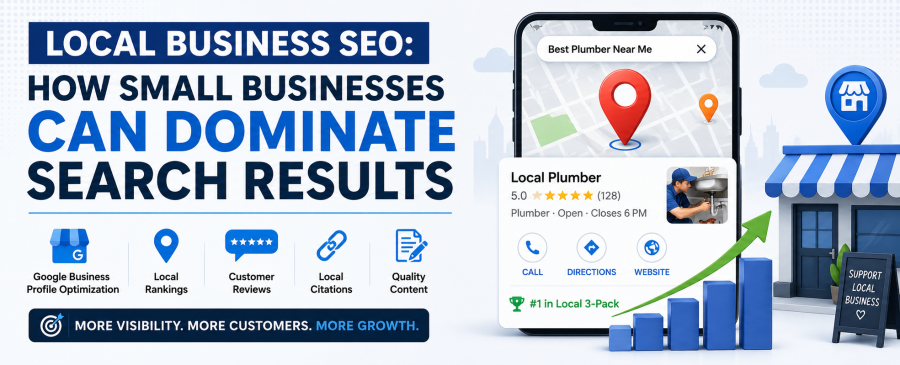
Running a small business is challenging enough without wondering why a competitor across the street appears above you on Google Maps. At Map Ranks, we’ve helped businesses across multiple industries improve their local visibility by optimizing Google Business Profiles, fixing citation issues, and creating location-focused SEO strategies. One thing remains consistent: businesses that follow a structured local SEO strategy consistently outperform those relying on outdated tactics. In this guide, we’ll explain the exact strategies that continue to work in 2026 for Google Search, Google Maps, AI Overviews, ChatGPT, and other AI-powered search platforms.
Key Takeaways
- A strong local SEO strategy combines Google Business Profile optimization, citations, reviews, and high-quality content to improve local search rankings.
- Ranking in the local 3-pack matters more than ranking on page one of standard results.
- AEO (Answer Engine Optimization) and GEO (Generative Engine Optimization) have become essential components of modern local SEO strategies, rather than separate approaches.
- Consistent optimization outperforms one-time SEO efforts.
- Reviews, NAP consistency, and geo-targeted content are the three fastest levers to pull.
What Is Local Business SEO?
Local business SEO is the practice of optimizing your online presence so nearby customers find you first when they search for what you sell. It covers your Google Business Profile, website content, citations, and reviews.
Think of it as the difference between having a store and having a store with a working sign, clear hours, and a friendly employee out front pointing people in. Search engines need those same signals. Without them, your business is technically there but practically invisible.
Optimizing for local search is very different from national SEO. While national campaigns aim to rank across the country, a local SEO strategy focuses on attracting nearby customers who are actively searching and ready to buy.
Why Does Local Business SEO Matter So Much in 2026?
Most local searches never make it past the map results. If you’re not in that top cluster, you’re losing customers before they even see your website.
Search behavior has shifted hard toward “near me” queries and voice assistants. People don’t type “best plumber in Ohio” anymore. They ask their phone, “Who can fix my water heater right now?” and expect an answer, not a list of ten blue links. According to BrightLocal’s Local Search Ranking Factors study, Google Business Profile signals are rated by SEO practitioners as the single biggest factor in local pack rankings, ahead of both on-page signals and backlinks. That one stat alone should tell you where to spend your first hour of effort.
Here’s what strong local business SEO actually delivers:
- More phone calls from people ready to hire, not just browse
- Improved visibility in Google Maps and the Local Pack
- Stronger trust signals through consistent business data
- Better long-term ROI than paid ads, since rankings keep working after you stop actively pushing
- A real edge over competitors who still treat their Google listing as an afterthought
What Are the Core Local SEO Strategies That Actually Work?
The core strategies are Google Business Profile optimization, citation consistency, review generation, geo-targeted content, and local backlinks. Skip any one of these, and the others work harder to compensate.
1. Fully Optimize Your Google Business Profile
Your profile is your storefront now. Fill out every category, every service, every photo slot. Businesses with incomplete profiles lose to competitors with complete ones almost every time, even when the incomplete profile has been around longer.
Add posts weekly. Answer the Q&A section. Upload real photos, not stock images. Google rewards activity, and customers trust it.
2. Fix Your NAP Consistency
NAP means Name, Address, and Phone. If your business name is listed one way on your website and slightly differently on Yelp or Facebook, that inconsistency quietly drags down your rankings.
Run a quick audit across your top 20 directories. Fix mismatches. It’s tedious, but it’s one of the highest-impact tasks in small business SEO.
3. Build a Review Engine, Not Just Reviews
One five-star review a month won’t cut it against a competitor collecting ten a week. Set up a simple system: ask every satisfied customer, send a text with a direct link, and respond to every review within 48 hours.
Recency matters as much as volume. Google and customers both notice when your last review is six months old.
4. Create Real Local Content
Generic “About Us” pages don’t rank. Write content around your actual service area: neighborhoods, landmarks, local events you sponsor, and problems specific to your climate or region.
If you serve five cities, each deserves its own page, written for a human first. Duplicate content with swapped city names gets ignored by search engines and skipped by readers.
5. Earn Local Backlinks
A mention from your local chamber of commerce or a community newspaper carries more local weight than a generic directory link. Sponsor a little league team. Partner with a nearby complementary business for a joint blog post. These local partnerships build credibility and authority that competitors can’t easily replicate.
How Do AEO, GEO, and AIO Fit Into Local Business SEO?
AEO, GEO, and AIO optimize your content so AI tools like ChatGPT, Perplexity, and Google AI Overviews can pull your business into direct answers, not just traditional search results.
This is genuinely new territory, and small businesses that ignore it are handing an advantage to competitors. AI answer engines pull from the same signals as traditional local search SEO: your Google Business Profile, structured FAQ content, and consistent citations across the web. The difference is presentation. Clear, direct answers written in plain language get pulled into AI summaries far more often than dense marketing copy.
That’s why we structure content (including this post) with direct answers right after each heading. It’s not a trick. It’s how both humans skimming on their phone and AI models parsing your page actually consume information.
How Long Does Local Business SEO Take to Show Results?
Most small businesses see measurable movement in Google Maps rankings within 60 to 90 days of consistent work. Full 3-pack dominance in competitive markets can take longer.
Unlike paid ads, the gains compound. A business that’s been doing this for two years has a moat that’s genuinely hard to cross with a six-month effort.
Common Mistakes That Quietly Kill Local Rankings
- Ignoring negative reviews instead of responding professionally
- Stuffing keywords into business descriptions instead of writing naturally
- Letting citations sit inconsistently across directories for years
- Treating the website and the Google Business Profile as separate projects
- Publishing one blog post and calling it “content marketing”
If any of these sound familiar, you’re not alone. Most businesses we talk to are making at least two of them.
If you want a deeper technical breakdown of Google Maps ranking specifically, our Google Maps SEO services page covers the mechanics in detail. And if you’d rather have a dedicated team handle the entire strategy for you, our local SEO company page walks through exactly how we do it, manually, without shortcuts.
Want a strategy built around your specific city and industry? Visit our homepage to see how Map Ranks approaches local growth for small businesses across the USA.
Why Trust Map Ranks?
At Map Ranks, our team specializes in local SEO, Google Business Profile optimization, Google Maps ranking strategies, citation management, and AI search optimization. We work with businesses across multiple industries and continually test strategies based on real campaign performance rather than outdated SEO theories.
FAQs
What is the difference between local SEO and local business SEO?
They’re largely the same concept, though “Local Business SEO” emphasizes the small business angle: practical, budget-conscious strategies rather than enterprise-level campaigns.
Do I need a website for local SEO to work?
A website helps significantly, but your Google Business Profile can drive real results even for businesses without a full site yet. We recommend building both over time.
How much does small business SEO typically cost?
Costs vary widely based on your market and competition, ranging from a few hundred dollars a month for DIY tools to several hundred for a managed service. The right number depends on how competitive your city and industry are.
Can local search SEO help me show up in AI search results?
Yes. AI tools pull from your Google Business Profile, reviews, and structured content, the same assets that power traditional local rankings.
How often should I update my Google Business Profile?
Weekly is ideal. Posts, photos, and review responses signal an active, trustworthy business to both Google and potential customers.
Does local business SEO help voice search?
Yes. Voice assistants rely on local SEO signals such as your Google Business Profile, customer reviews, accurate business information, and well-structured website content to recommend nearby businesses.

Map Ranks is a local SEO agency that helps businesses get found fast on Google Maps and local pack. Our team specializes in Google Maps Marketing, SEO, and optimization strategies designed to boost your visibility, attract nearby customers, and grow your local presence. We make sure your local business stands out right where it matters; on the map and in front of the people searching for you.