

Google Business SEO in 2026: What’s Actually Driving Rankings Now?
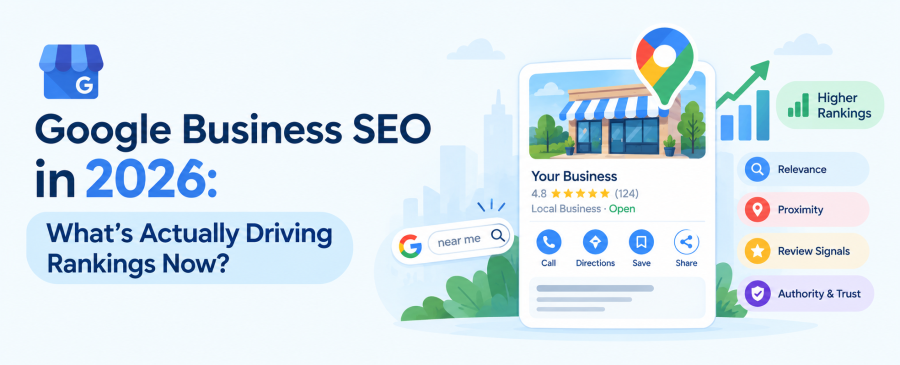
Google Business SEO in 2026 is no longer driven by surface-level optimization. Google local ranking is now influenced by engagement depth, behavioral data, entity authority, trust validation, and how well your Google Business Profile connects with your website ecosystem. Traditional ranking signals still matter, but they are no longer enough.
Key Takeaways
- User engagement now directly influences Google Business ranking.
- Entity authority and niche depth are emerging as strong GBP ranking factors.
- Behavioral signals outweigh simple keyword placement.
- Website and GBP integration significantly impact visibility.
- Spam control and trust validation are stricter than ever.
Google Business SEO in 2026 depends on five things working together: user engagement (clicks, calls, direction requests), profile activity consistency, entity authority in your niche, review context, and how well your website supports your GBP claims. Businesses relying only on profile completion are already falling behind.
Why Are Some Local Businesses Suddenly Losing Rankings?
Rankings are dropping for businesses that treat their profile as a one-time setup instead of an active channel. Google now rewards ongoing behavior, not a completed checklist.
Two businesses. Same city. Same category. Similar review count. Yet one dominates the local pack while the other disappears from visibility.
This shift defines Google Business SEO in 2026. Google has moved from evaluating static optimization to analyzing dynamic performance. Google local ranking is shaped by how users interact with your business, how clearly your authority is defined, and how consistent your digital ecosystem appears.
In our own audits, ranking drops are rarely caused by missing keywords. They’re caused by strategic gaps between the profile, the website, authority signals, and engagement data. Those gaps matter more than ever this year.
Engagement Signals Have Become Authority Signals
Google is no longer impressed by a perfectly filled-out profile. It wants evidence that real users are choosing your business.
When users click, call, request directions, explore photos, or visit your website, Google reads that behavior as market validation. These behavioral interactions have quietly become some of the strongest GBP ranking factors in 2026.
A business with moderate reviews but strong interaction metrics can now outperform a competitor with more reviews but lower engagement depth.
Activity Consistency Signals Business Stability
A profile that goes quiet for weeks signals reduced reliability to Google. Regular updates do the opposite; they reinforce trust.
Google Business ranking now reflects operational consistency. A profile that appears stagnant sends subtle signals of reduced activity or lower reliability. On the other hand, consistent updates, fresh interactions, and responsive communication reinforce trust signals in the system.
This shift aligns with Google’s broader direction, favoring businesses that demonstrate ongoing presence rather than one-time configuration.
Stability and activity now influence how confidently Google surfaces your listing in competitive local results.
Website and Google Business Profile Are Now Deeply Connected
A major change in Google Business SEO is how tightly your profile performance is tied to your website strength.
Google cross-references:
- Service clarity.
- Content relevance.
- Local keyword integration.
- Technical SEO health.
- Information consistency.
If your website lacks depth, authority, or a clear service definition, your Google local ranking will reflect that weakness.
In 2026, a profile cannot compensate for a weak website. The algorithm evaluates the business as a unified entity, not separate assets.
Businesses that treat their website and GBP as one integrated local SEO system consistently outperform those optimizing them independently.
Entity Authority Is Replacing Keyword Density
Google now asks whether your business genuinely represents authority in its category, not just whether your listing contains the right keywords.
One of the most significant ranking shifts is the move toward entity-based evaluation. If a business lists multiple services without demonstrating depth or expertise, its authority score weakens. When service specialization is clear and consistently reinforced across the web, entity strength improves.
Entity authority has become one of the most underestimated GBP ranking factors, something we cover in more depth in our guide to Google Business Profile ranking factors in 2026.
Google wants to understand:
- What your business truly specializes in
- Whether your digital presence supports that specialization
- If your authority aligns with your selected categories
This is why niche clarity now matters more than broad service lists.
Review Signals Are Now About Context, Not Quantity
Reviews remain important, but the evaluation criteria have matured.
Google Business ranking is influenced not only by how many reviews you have, but by:
- Contextual depth within reviews.
- Sentiment consistency.
- Reviewer credibility patterns.
- Natural frequency distribution.
Robotic review responses and templated engagement patterns reduce authenticity signals. Google’s systems are increasingly capable of identifying unnatural behavior patterns.
Meaningful, contextual engagement now carries more weight than volume alone.
The shift reflects Google’s broader priority: rewarding authenticity over manipulation.
Spam Filtering and Trust Validation Are Stricter
Fake locations, keyword-stuffed names, and review manipulation are getting filtered more aggressively than in past years.
Google Business SEO now rewards authenticity, verification, and consistency across platforms. Trust signals such as accurate business data, legitimate citations, and real engagement patterns reinforce ranking stability.
Shortcuts are disappearing. Structured strategy is replacing manipulation, and that trend is only getting stronger.
Behavioral Click Patterns Influence Visibility
Google tracks how users behave after encountering your profile.
If users frequently click your listing, interact with your content, and engage with your website, those behavioral patterns strengthen your visibility over time.
Click-through behavior, dwell time, and interaction depth act as reinforcement signals.
This is why brand perception and profile presentation matter more than ever, something we break down further in why some businesses always appear at the top of Google Maps. Visibility isn’t static anymore. It compounds based on user behavior trends.
Common Myths About Google Business SEO in 2026
More reviews do not automatically guarantee a higher Google Business ranking. Engagement quality now plays a stronger role. Adding keywords aggressively does not boost Google local ranking. Over-optimization often triggers filtering.
A completed profile does not equal sustained ranking. Continuous authority and engagement are now required. A Google Business Profile alone cannot dominate results. Website strength and entity consistency are essential.
Understanding these realities separates businesses that stagnate from those that scale.
The Strategic Framework for 2026
Improving Google Business SEO this year takes a unified approach across engagement data, website alignment, review strategy, and authority building, not isolated fixes.
- Analyze engagement data beyond surface metrics. Interaction patterns give real insight into ranking movement.
- Strengthen website alignment with your profile positioning to reinforce entity authority.
- Shift review strategy toward contextual credibility rather than simple volume growth.
- Build local authority signals consistently and strategically, not reactively.
This integrated framework reflects how modern GBP ranking factors actually operate. For the official breakdown of Google’s core ranking criteria, relevance, distance, and prominence, see Google’s own guide on improving local ranking.
Want These Ranking Factors Working for Your Business?
Reading about ranking factors is one thing. Having someone actually audit your profile against them is another. If you want a clear picture of where your listing stands on engagement, authority, and trust signals, our team can walk through it with you.
Call us at 800-638-6384 or contact us here to talk through your current rankings. You can also run a free listing scan first if you’d rather see the gaps yourself before the call.
FAQs:
What are the most important GBP ranking factors in 2026?
Engagement signals, website alignment, review quality, entity authority, and consistent activity are among the strongest GBP ranking factors today.
Is Google’s local ranking still influenced by proximity?
Yes, but proximity is now combined with engagement data and service area signals. It’s more behavior-driven than before.
How often should a Google Business Profile be updated?
Ideally, updates should be made weekly. Regular posts, image uploads, and timely review responses help maintain strong activity signals and improve Google Business ranking performance.
Does my website affect my Google Business ranking?
Absolutely. Website SEO, local keyword optimization, speed, and content relevance directly influence Google Business ranking.
Are reviews still important for Google Business SEO?
Yes, but quality and consistency matter more than just quantity. Detailed reviews with meaningful owner responses perform better.
Can a business rank in multiple areas with one profile?
Yes, ranking in multiple areas is possible. However, success depends on service area authority, engagement zones, and strong website support, not simply adding more locations.
How long does it take to see ranking improvements after making these changes?
Most businesses start seeing early movement within 4 to 6 weeks of consistent activity and profile updates. Stronger, more competitive markets can take a couple of months of sustained effort before rankings stabilize higher.

Map Ranks is a local SEO agency that helps businesses get found fast on Google Maps and local pack. Our team specializes in Google Maps Marketing, SEO, and optimization strategies designed to boost your visibility, attract nearby customers, and grow your local presence. We make sure your local business stands out right where it matters; on the map and in front of the people searching for you.