

How Long Does It Take a Google Maps Company to Improve Rankings?
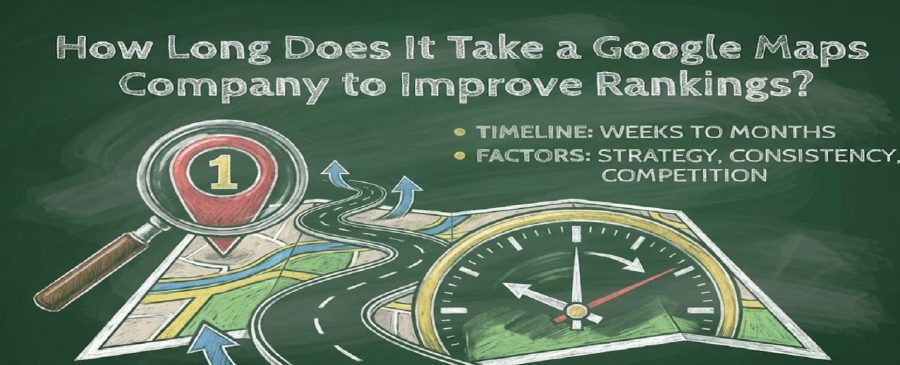
This blog explains how long it typically takes a Google Maps company to improve local rankings and what businesses should realistically expect from the process. It covers how Google Maps rankings work, including the role of relevance, proximity, and prominence, and why results do not happen instantly. The blog also discusses how a strong GBP ranking strategy can influence performance, highlighting situations where rankings may improve faster, why Google Maps SEO should be treated as a long-term investment, and how progress should be measured beyond rankings alone. By the end, readers clearly understand the expected timelines, key influencing factors, and the importance of consistent, ethical optimization for achieving sustainable Google Maps visibility and long-term business growth.
Key Takeaway Points
- The blog focuses on realistic timelines for Google Maps ranking improvements.
- It explains how Google determines Maps rankings and what a Google Maps company can control.
- Faster results are possible, but only under specific conditions.
- Google Maps SEO is positioned as a long-term strategy, not a quick fix.
- Measuring success requires tracking calls, clicks, directions, and reviews—not just rankings.
- Most businesses can expect noticeable progress within 2–3 months and stronger results in 4–6 months.
Understanding How Google Maps Rankings Work
Before discussing timelines, it is important to understand how Google determines Maps rankings. Google Maps results commonly known as the Local 3-Pack are influenced by three primary factors:
1. Relevance
Relevance measures how closely your business listing matches a user’s search intent. This is where GBP Optimization plays a critical role. Optimizing business categories, services, descriptions, and keywords helps Google clearly understand what your business offers.
2. Proximity
Proximity refers to how close a business is to the searcher’s location. This factor cannot be controlled ethically, which is why reputable Google Maps service providers focus on the elements they can improve.
3. Prominence
Prominence reflects how well-known and trusted your business appears online. Reviews, citations, backlinks, engagement signals, and brand mentions all contribute to prominence.
Effective Local Maps SEO focuses on maximizing relevance and prominence to improve rankings consistently and compliantly.
Typical Timeline for Google Maps Ranking Improvements
While every market is different, most businesses experience progress in stages:
First 30 Days: Foundation & Cleanup
In the first month, a Google Maps company focuses on:
- Complete GBP Optimization
- Fixing NAP inconsistencies
- Correcting category and service errors
- Removing duplicate or spam listings
- Establishing baseline rankings and metrics
Visible ranking jumps are uncommon at this stage, but engagement metrics often begin improving.
2–3 Months: Early Movement
This is when businesses typically see:
- Improved visibility for branded and low-competition keywords
- Increased profile views and discovery searches
- More calls and direction requests
At this stage, Local map pack optimization efforts begin to take effect as Google reprocesses updated trust signals.
4–6 Months: Stronger Rankings & Lead Growth
By months four to six, most businesses experience:
- Consistent Local 3-Pack visibility
- Higher conversion rates from Maps traffic
- Reliable Google Maps lead generation
- Improved rankings for competitive keywords
This is where Google Maps SEO delivers measurable ROI.
Can Google Maps Rankings Improve Faster?
Yes—but only under specific conditions.
Faster results are possible when:
- Competition is weak or moderate
- The business profile has never been optimized
- Major errors were holding rankings back
- The business already has strong reviews and engagement
However, any provider promising instant #1 rankings should be avoided. Ethical Local Maps SEO follows Google’s guidelines and focuses on sustainability, not shortcuts.
Why Google Maps SEO Is a Long-Term Investment
Google Maps rewards consistency. Unlike ads, where visibility disappears once the budget stops, optimized Maps listings continue generating leads long after the initial work is completed.
Long-term benefits of Google Maps Service optimization include:
- Lower customer acquisition costs
- Stable inbound calls and directions
- Increased brand trust and credibility
- Reduced dependency on paid advertising
With proper maintenance, Local map pack optimization compounds over time, making it one of the most cost-effective local marketing strategies.
The Role of GBP Optimization in Ranking Success
A fully optimized Google Business Profile is the foundation of Maps success. GBP Optimization includes:
- Accurate primary and secondary categories
- Keyword-aligned service listings
- Optimized business descriptions
- High-quality photos and videos
- Consistent posting and updates
- Review management and responses
Without strong GBP Optimization, even aggressive SEO efforts will struggle to deliver long-term results.
Measuring Success Beyond Rankings
Rankings alone do not tell the full story. A professional Google Maps Service tracks performance using multiple KPIs, including:
- Map pack visibility across different locations
- Calls generated from Google Business Profile
- Direction requests and website clicks
- Review growth, quality, and sentiment
- Conversion trends tied to Maps traffic
These metrics collectively indicate whether Google Maps lead generation is improving—not just keyword positions.
Common Reasons Rankings Fluctuate Early On
Ranking fluctuations are normal during the first few months. Google often tests updated listings before stabilizing positions.
Common causes include:
- Algorithm recalibration
- New citations and reviews being indexed
- Competitor optimization activity
- Engagement pattern changes
Consistent Local Maps SEO efforts usually lead to stability over time.
Final Thoughts
So, how long does it take a Google Maps company to improve rankings?
For most businesses, noticeable improvements appear within 2–3 months, with strong and competitive Local 3-Pack rankings achieved in 4–6 months. The exact timeline depends on competition, location, business history, and the quality of Local map pack optimization.
Businesses that treat Google Maps SEO as a long-term growth strategy—not a quick fix—consistently achieve better visibility, stronger trust, and sustainable Google Maps lead generation.
FAQs
How long does it take to rank in the Google Maps 3-Pack?
Most businesses take 3–6 months to consistently appear in the Local 3-Pack, depending on competition and optimization quality. Improving your Google business ranking during this period requires consistent local SEO efforts and accurate business information.
Can Google Maps bring real leads, not just visibility?
Absolutely. Proper optimization increases calls, direction requests, and website visits from ready-to-buy customers.
Do reviews impact Google Maps rankings?
Yes. Reviews affect prominence, trust, and conversions. Quantity, quality, recency, and relevance all matter.
Is Google Maps SEO faster than traditional SEO?
In most cases, yes. Local Maps SEO often shows results faster than organic website SEO for local-intent searches.
What happens if optimization stops?
Rankings may slowly decline as competitors continue optimizing. Ongoing maintenance protects long-term visibility.

Map Ranks is a local SEO agency that helps businesses get found fast on Google Maps and local pack. Our team specializes in Google Maps Marketing, SEO, and optimization strategies designed to boost your visibility, attract nearby customers, and grow your local presence. We make sure your local business stands out right where it matters; on the map and in front of the people searching for you.