

How Can I Achieve Ranking #1 on Google Maps?
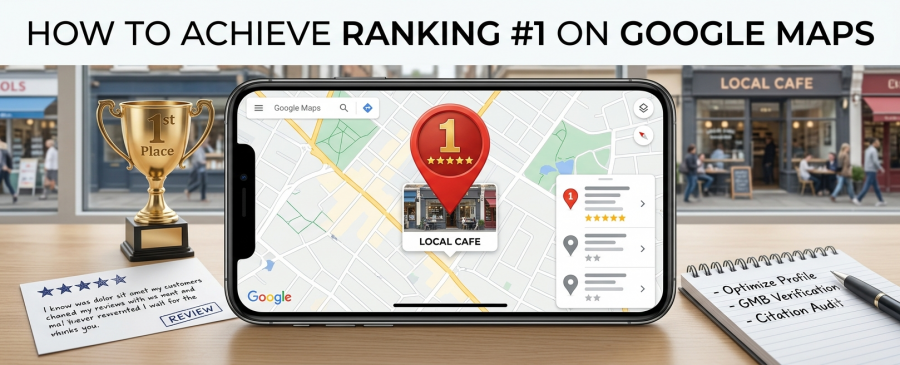
“Near me” searches turn into phone calls fast. When someone searches for a plumber, dentist, or coffee shop nearby, they almost always tap the first Google Maps listing they see. At Map Ranks, we manage Google Business Profiles for local businesses every day, and we track what moves rankings and what doesn’t across hundreds of listings in different industries and cities. The pattern never changes: the business at the top gets the call, and the rest fight over what’s left.
This guide walks through exactly what it takes to rank #1 on Google Maps, based on changes we’ve personally tested on client profiles, not guesswork or recycled advice. Where a tactic worked fast, we say so. Where it took months, we say that too.
Key Takeaways
- Google Maps ranking comes down to three things: relevance, distance, and prominence.
- A fully completed Google Business Profile consistently outranks a partial one.
- Reviews, especially recent ones that mention your service or city, carry real weight.
- NAP (Name, Address, Phone) consistency across the web still matters in 2026.
- Local backlinks and citations build the authority signal Google looks for.
- Ranking #1 is not a one-time task. It needs ongoing attention.
To improve your chances of ranking #1 on Google Maps, focus on the three core local ranking factors: relevance, distance, and prominence. Optimize your Google Business Profile, maintain accurate business information, earn genuine reviews, build local authority, strengthen your website, and consistently improve your overall local presence. There is no guaranteed shortcut to the #1 position because map rankings vary by searcher location, competition, and query.
Why Ranking #1 on Google Maps Matters
Local search behavior is changing fast. People skip websites and go straight to Maps to compare ratings, view photos, and contact businesses instantly. A top Maps ranking leads to more calls, more store visits, and more bookings, without paying for ads.
Google prioritizes businesses that provide the best user experience, accurate information, and strong local credibility. The more trust signals your listing gives, the higher your chance of improving your Google business ranking and reaching #1.
Fully Optimizing Your Google Business Profile
Complete Every Section of the Profile
Your Google Business Profile (formerly Google My Business) is the foundation of everything you do on Maps. For a strong Google My Business ranking, Google prefers complete and well-maintained profiles. That means adding accurate business details, choosing the correct categories, writing a strong description with natural keywords, updating your hours, and adding your website link.
Add High-Quality Visuals
Photos and videos play a major role in ranking. Businesses with active photo uploads appear more trustworthy to Google. Upload real images of your storefront, team, work in progress, and finished jobs. Skip stock photos. Customers can tell the difference, and so can Google over time.
Maintaining NAP Consistency Across the Internet
What is NAP, and why does it matter?
NAP stands for Name, Address, and Phone Number. Google compares this information across all platforms to verify your credibility. If your details differ even slightly between directories, social media, or websites, Google can lose confidence, which lowers your Google business ranking.
Where Consistency Must Be Maintained
Your NAP must match exactly on your website, Facebook, Instagram, business directories, industry platforms, and third-party listings. This consistency helps Google confirm that your business is legitimate and reliable—one of the key local SEO ranking factors.
Building Strong Review Signals
Focusing on Steady, Genuine Reviews
Reviews are one of the strongest ranking factors on Google Maps. Google prefers a business that gets continuous reviews over time rather than dozens at once. Aim for a steady flow of authentic feedback to improve Google Maps visibility.
Responding to Reviews to Improve Engagement
Replying to reviews—both positive and negative—improves your overall trust score. Google sees this engagement as a sign that your business is active and values customer experience.
Encouraging Descriptive Customer Reviews
When reviewers naturally mention city names or service keywords, Google uses that as a relevance signal. For example, “Great plumbing service in Parramatta” helps support your Google My Business ranking for that exact search.
Posting Regular Updates on Your Profile
How Google Uses Posts for Visibility
Many businesses ignore the Posts feature, but Google rewards profiles that stay active. Posting updates, offers, service highlights, events, FAQs, or new projects shows Google that your business is engaged and up-to-date, helping improve Google Maps visibility.
What Type of Content You Should Post
Share weekly posts that speak to your services and your location. Content like “New roof restoration completed in Liverpool” or “Holiday dental check-up specials available this week” helps improve local relevance and overall Google Business Ranking.
Build Local Citations the Right Way
Citations are mentions of your business name, address, and phone number on other websites, directories, and platforms. They act as a trust signal for Google.
Thirty strong citations beat three hundred spammy ones. Focus on:
- Established industry directories for your specific trade
- Local chamber of commerce or business association listings
- Community and neighborhood sites relevant to your service area
Strengthening Your Website for Local SEO
Your Maps ranking is tied to how strong your website is for local search. A slow, outdated site with no local content will hold your Maps ranking back, no matter how good your profile looks.
Build a dedicated page for each area you serve, add your city and neighborhood names naturally into the copy, and include local business schema markup. A fast, mobile-friendly site with clear internal linking supports everything you’re doing on your profile. This is the kind of technical groundwork our Google Maps SEO service handles for clients who don’t have time to manage it themselves.
Creating Content That Establishes Local Authority
Using Local Topics to Build Relevance
Publishing blog posts or guides related to your area helps Google understand your connection to the community. Topics like “Best cafés in Bondi we recommend” or “What to look for in a Marrickville electrician” help build geographic relevance.
Showcasing Local Projects or Case Studies
Share stories of successful jobs completed in specific suburbs. These become proof of local experience and help your listing appear for area-based searches—another tactic used by the best Google Maps company.
Choosing Targeted Service Areas Wisely
Avoid Overloading Service Areas
Many service-area businesses make the mistake of listing 20–30 suburbs. This confuses Google. Focus on a smaller group of core locations where you truly want to rank.
Aligning Service Areas with Website Pages
Your website must support your service areas with content. A Google listing alone won’t rank if your site does not reflect your locations.
Building Local Backlinks for Authority
Why Backlinks Matter for Maps Ranking
Backlinks remain one of the strongest local SEO ranking factors. Local backlinks from community websites, local newspapers, neighborhood groups, or nearby businesses boost your authority more than generic ones.
Ways to Earn Strong Local Backlinks
Sponsoring a local sports event, partnering with local charities, or getting featured in a neighborhood journal can produce powerful local backlinks and instantly improve Google Maps visibility.
Keeping Your Google Business Profile Active
Signals Google Looks For Over Time
Google prefers businesses that keep their information updated. Adding new photos, updating business hours, posting weekly content, and maintaining a stream of reviews tells Google you are an active and trustworthy business—key for Google Business Ranking.
The Importance of Ongoing Optimization
Ranking #1 is not a one-time achievement. It requires regular effort. The businesses that dominate Maps rankings treat their Google Business Profile as an ongoing marketing channel.
How Long It Takes to Achieve a #1 Google Maps Ranking
The timeframe varies depending on competition, industry, population density, and how well-optimized your profile and website are. In smaller towns, results can appear in a few weeks; in competitive metro areas, it may take several months. The key is consistency—Google rewards businesses that maintain optimization long-term.
Ready to Improve Your Google Maps Rankings?
Ranking #1 on Google Maps is realistic for almost any business willing to put in consistent work: a complete profile, genuine reviews, local citations, and a website that backs up your service areas. None of these steps are complicated on their own. The businesses that win are the ones that keep doing them month after month.
If you’d rather have a team handle this for you, our Google Maps ranking specialists can audit your current profile and tell you exactly where you’re losing ground. You can also grab a free listing scan to see where things stand right now or head back to our homepage to see how we work with local businesses like yours.
FAQs
How do I improve my Google Maps ranking quickly?
Complete your Google business profile, get new reviews consistently, post weekly updates, and ensure your NAP details are accurate everywhere.
Can I rank #1 without a website?
It’s possible but more difficult. A strong website improves your local authority and increases your chances of reaching the top results.
Do Google Posts improve rankings?
Yes. Profiles that post regularly show up as more active, and Google tends to favor active, engaged listings over dormant ones.
How many reviews do I need to rank #1?
There’s no fixed number. What matters more is a steady pace of new reviews, a strong average rating, and reviews that mention your service or location.
Why is my business not showing up on Google Maps?
Your listing may be unverified, suspended, missing key information, or simply too new to have built up authority yet. Newer listings take time to appear for competitive searches.
Can a service-area business rank in multiple suburbs?
Yes, but each suburb needs its own supporting content on your website and a genuine service history there. Listing a suburb with no backup content rarely ranks.
What’s the single biggest local SEO ranking factor in 2026?
Review volume and recency currently carry the most weight for most industries, though a complete, well-categorized profile is still the baseline everything else builds on.
Does having multiple business locations affect Google Maps ranking?
Each location needs its own verified profile, its own reviews, and its own local citations. Ranking one location well doesn’t automatically help a sister location rank.

Map Ranks is a local SEO agency that helps businesses get found fast on Google Maps and local pack. Our team specializes in Google Maps Marketing, SEO, and optimization strategies designed to boost your visibility, attract nearby customers, and grow your local presence. We make sure your local business stands out right where it matters; on the map and in front of the people searching for you.